Skip to product information
1 of 6

PrimalBasics

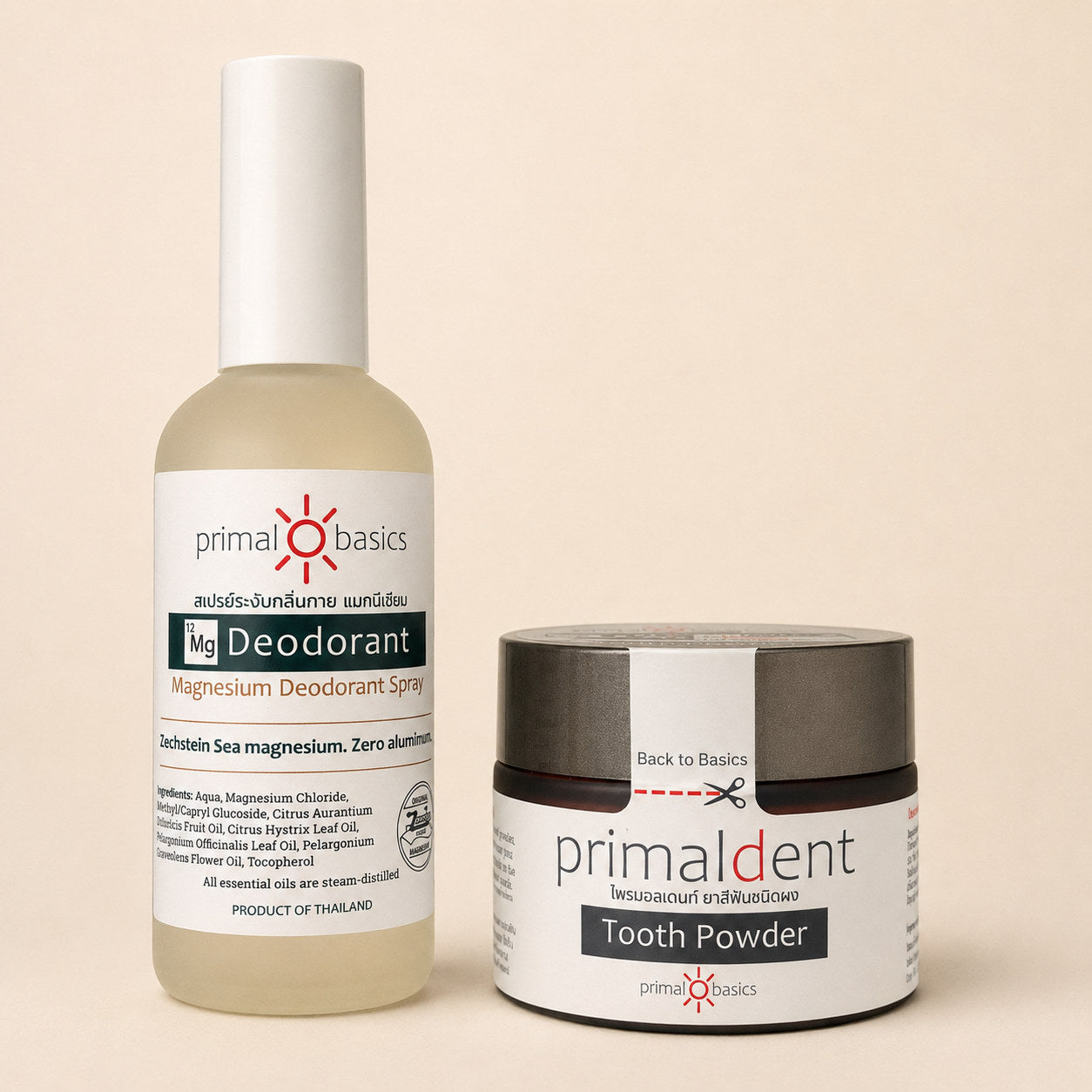
PrimalDent — Mineral Tooth Powder

PrimalDent — Mineral Tooth Powder

Regular price ฿ 490
Regular price Sale price ฿ 490
Sale Sold out
Shipping calculated at checkout.
Quantity

 Four ingredients. That's it.

✓ PrimalBasics Guarantee — 60-day returns, even empty →

In stock · Ships in 1–2 business days

Free shipping in Thailand

Pay with Thai QR (PromptPay)

Formulated by Mike in Bangkok. Manufacturing partner: MSRI (Medical Science and Research Innovation Institute) at Prince of Songkla University. How we manufacture →

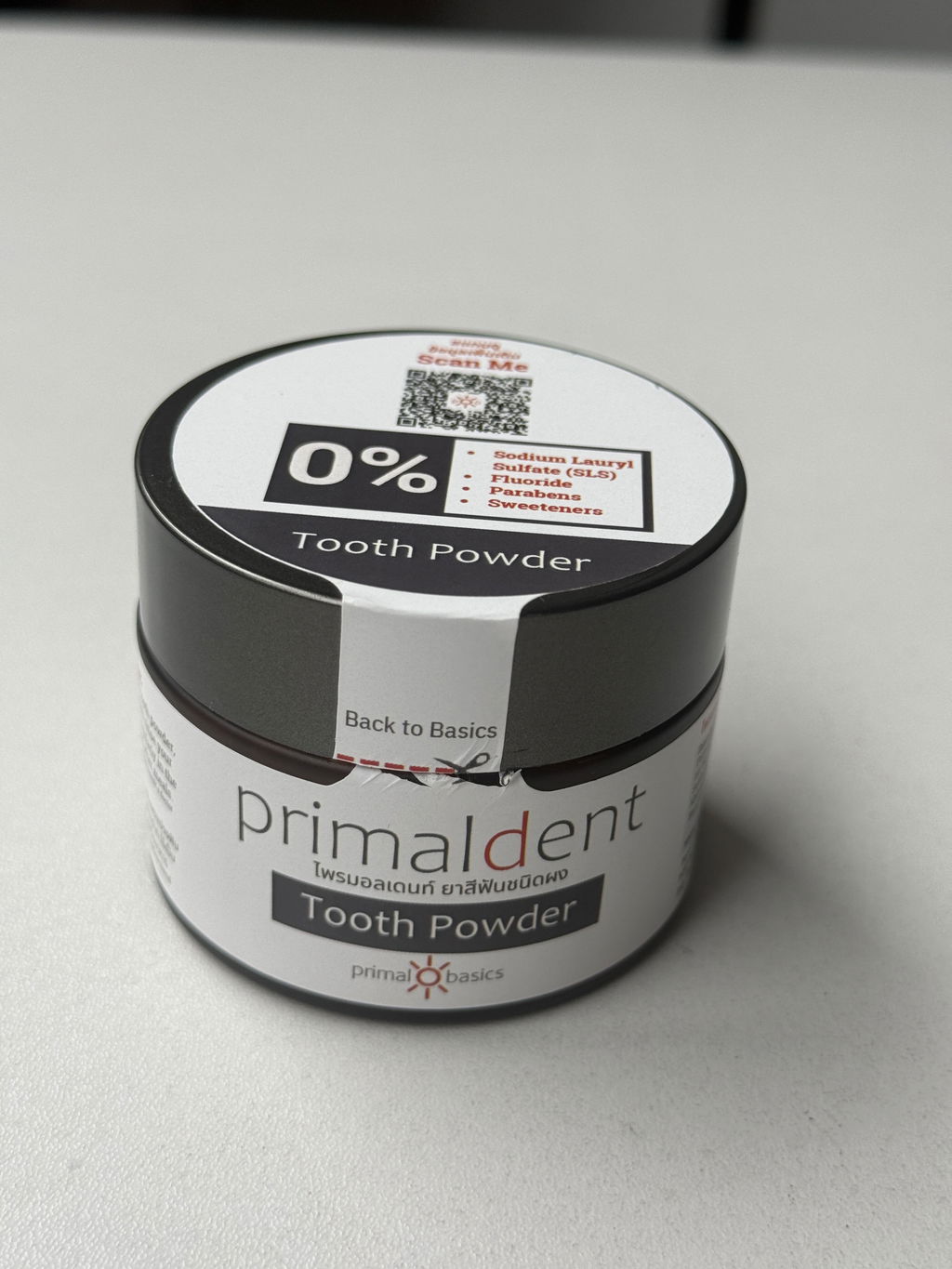
Bentonite clay, sodium bicarbonate, Ceylon cinnamon, and steam-distilled peppermint essential oil. No fluoride, no SLS, no glycerin, no sweeteners, no artificial foaming agents. The tooth powder we made for ourselves in 2018, still formulated the same way.

Why this product exists

The trouble with most toothpastes is that they contain things that have nothing to do with cleaning teeth. Sodium lauryl sulfate exists to make the paste foam. Foam does not clean anything. Glycerin exists to keep the paste fluid in a tube. A powder does not need it. Artificial sweeteners exist to overcome the bitterness of the functional ingredients — they are not required if the functional ingredients are not bitter. Our tooth powder dispenses with all of that. The clay is lightly abrasive and mineral-rich. The sodium bicarbonate neutralises oral acid. The cinnamon and peppermint are antimicrobial. You brush, you swish, you swallow the mineral-rich water. Six-week jars. Twice-daily use.

Pairs with: Magnesium Deodorant, Bio Clean, Bio Glide.

Regulatory: Thai FDA cosmetic registration 90-1-6800016470.

View full details

OUR STANDARD

The 0% Standard™ — what this product excludes

  • 0% fluoride
  • 0% sodium lauryl sulfate
  • 0% glycerin
  • 0% artificial sweeteners
  • 0% synthetic fragrance
  • 0% plastic packaging
  • 0% phthalates
  • 0% parabens
Read the full 0% Standard →

EVERY INGREDIENT, EXPLAINED

What's in the bottle

  • Bentonite ClayMineral-rich mild abrasive

    INCI: Bentonite

    Bentonite is a smectite clay formed from weathered volcanic ash. Its layered aluminosilicate structure gives it a surface area roughly 50 times that of kaolin, and that structure is why a single particle does two different kinds of work.

    First, the smectite layers are mildly abrasive at the particle size we use — finer than the calcium carbonate in most toothpastes.

    Second, the surface is negatively charged — so it lifts what it loosens and holds onto it, rather than pushing it around your mouth. The clay also carries calcium, magnesium and silica in its own structure.

    Sourced in Thailand.

  • Sodium BicarbonatepH neutraliser and mild abrasive

    INCI: Sodium Bicarbonate

    Sodium bicarbonate — plain baking soda, cosmetic grade — is one of the oldest and best-studied oral-care ingredients in the world. Two things make it worth the space.

    It is a buffer: it neutralises acids, which is the whole reason it has been in mouths and on kitchen shelves for a century.

    And it is mildly abrasive at the right particle size, lifting surface plaque without the harder action of the silicas used in commercial whitening pastes. The RDA — relative dentin abrasivity, the standard industry measure — of baking soda at our particle size is roughly 7, against around 100 for the average toothpaste. That is a measured number, not a claim.

    Sourcing: Mined, not synthetic.

  • Ceylon CinnamonWarm note in the flavour

    INCI: Cinnamomum Zeylanicum Bark Powder

    Most of the cinnamon sold in the world is cassia (Cinnamomum cassia or C. aromaticum), a cheaper species from Vietnam and China. True cinnamon — Cinnamomum zeylanicum — grows in Sri Lanka and costs more for a reason: it carries a substantially lower coumarin load, and a different cinnamaldehyde-to-eugenol ratio.

    We use the ground bark, not an extract, at a concentration calibrated for taste — enough to feel it, not enough to overwhelm the peppermint finish.

    Present at 6.25%. A small subset of users (1–3%) experience cinnamaldehyde-related oral sensitivity; discontinue if you notice irritation.

  • Peppermint Essential Oil (Steam-Distilled)Antimicrobial and clean-finish note

    INCI: Mentha Piperita (Peppermint) Oil

    Peppermint essential oil is roughly 40% menthol, 20% menthone, and a collection of minor terpenoids including limonene and pinene. Menthol carries antimicrobial activity at low concentrations (documented against several oral pathogens) and, at the threshold we use it, delivers the clean finish that customers associate with a proper tooth product. We specifically use steam-distilled, not solvent-extracted, peppermint — solvent extraction alters the terpenoid ratio and leaves residue. Steam distillation is the traditional method and produces the most predictable oil. A minor but meaningful point: we use a peppermint rather than a spearmint. Spearmint is sweeter-tasting and more common in consumer products, but its dominant terpenoid (carvone) has weaker antimicrobial activity. The choice of peppermint is a functional one, not just a flavour one.

How to use

  1. Wet your toothbrush; shake off excess water.
  2. Dip the brush lightly into the powder.
  3. Tap excess powder back into the jar.
  4. Brush for 2 minutes as normal.
  5. Swish and swallow the mineral-rich water.

THE TIMELINE

What to expect

First brush: teeth feel noticeably cleaner than paste produces, because there is no glycerin film.

First week: the fresh feel persists through the morning.

First month: many users report reduced sensitivity and healthier gum appearance. Compounding effect over 6+ months.

QUESTIONS

Common questions

  • Does it foam?
    No. Foam is a cosmetic cue, not a functional one. The lack of SLS is a feature.
  • Can I use it with an electric toothbrush?
    Yes. Dip lightly — electric brushes need less product.
  • Will it stain my toothbrush or basin?
    Lightly, yes. Rinse the brush well; the bentonite washes from the basin with a quick wipe.
  • Is it safe for children?
    Yes — and naturally low-sugar with no artificial sweeteners. We use it with our own family.
  • Does it contain hydroxyapatite?
    No. We went a different way: baking soda for pH, bentonite for the physical clean, cinnamon and peppermint for flavour — and nothing in the formula whose only job is texture or foam. If hydroxyapatite is what you are looking for, this is not that product, and we would rather tell you than talk you round. Read the full case →

HOW WE COMPARE

Same category. Different formulation philosophy.

Product Size Price (USD) Per unit (USD) What's inside
Vanman's Miracle Tooth Powder (Mint-Bone) 57g $27 $0.47 6 ingredients. Grass-fed cattle-bone hydroxyapatite, bentonite clay, baking soda, organic xylitol, peppermint oil, sea salt. No fluoride, SLS, glycerin.
Primal Life Organics Dirty Mouth Tooth Powder 28g $11 $0.39 5 core ingredients + essential oils. Bentonite, kaolin, baking soda, nano-hydroxyapatite, montmorillonite. Activated charcoal + peppermint/spearmint oils.
RiseWell Mineral Toothpaste 96g $17 $0.18 13+ ingredients. Silica, sorbitol, glycerin, xylitol, 10% hydroxyapatite, calcium carbonate, propanediol, potassium cocoate, stevia, mint oils, cinnamon bark. Paste format.
Boka Ela Mint Nano-Hydroxyapatite 96g $15 $0.16 25+ ingredients. Water, vegetable glycerin, hydrated silica, sorbitol, nano-hydroxyapatite, sodium benzoate preservative, sodium lauroyl sarcosinate surfactant, essential oils, xylitol, xanthan gum, stevia, MSM, aloe, baking soda, fruit extracts.
PrimalDent — Mineral Tooth Powder 40g $15 $0.38 Four ingredients. Bentonite clay, sodium bicarbonate, Ceylon cinnamon, steam-distilled peppermint essential oil. Zero fluoride. Zero SLS. Zero glycerin. Zero sweeteners. Zero artificial foaming agents.

USD prices converted at 1 USD = 32 THB (April 2026 rate).

How a leading brand compares, ingredient by ingredient

A real cavity-protection toothpaste from a leading brand, run through The 0% Standard. Same yardstick, very different formula.

Sodium Fluoride Fails

Glycerin Acceptable

Silica 0% Approved

Sodium Lauryl Sulfate Fails

Arginine Acceptable

Fragrance Fails

Cocamidopropyl Betaine Acceptable

Zinc Oxide 0% Approved

Cellulose Gum Acceptable

CI 77891 0% Approved

Poloxamer 407 Borderline

Zinc Citrate Acceptable

Tetrasodium Pyrophosphate Borderline

Xanthan Gum Acceptable

Benzyl Alcohol Borderline

Phosphoric Acid 0% Approved

Sodium Saccharin Borderline
Run any product through the public lookup tool →X